


[Registration Open] (Webinar) The 142nd HGPI Seminar “World Kidney Day 2026” Theme in Focus: The Current State of Green Nephrology and Green Dialysis—Balancing Kidney Health and Planetary Health (March 10, 2026)
date : 2/27/2026
Tags: HGPI Seminar, Planetary Health

![[Registration Open] (Webinar) The 142nd HGPI Seminar “World Kidney Day 2026” Theme in Focus: The Current State of Green Nephrology and Green Dialysis—Balancing Kidney Health and Planetary Health (March 10, 2026)](https://hgpi.org/en/wp-content/uploads/sites/2/The142nd_HGPI_Seminar.jpg)
March 12 marks World Kidney Day. The theme for World Kidney Day 2026 is “Kidney Health for All – Caring for People, Protecting the Planet.” This year’s message highlights the importance of addressing kidney disease not only from the perspective of human health, but also in connection with the health of our planet.
Chronic kidney disease (CKD) often progresses silently in its early stages and may go unnoticed until it leads to serious health consequences. It increases the risk of cardiovascular complications and reduces quality of life, and when it advances to kidney failure, kidney replacement therapies such as dialysis or transplantation become necessary. The World Kidney Day campaign consistently emphasizes the importance of prevention and early detection—including simple blood and urine tests—to slow disease progression and prevent severe outcomes. At the same time, in recent years kidney disease has increasingly been discussed from two interconnected perspectives: “Climate to Kidney” (the impact of environmental factors on kidney health) and “Kidney to Climate” (the environmental impact of kidney care). On the environmental side, air pollution, heat stress, dehydration, and extreme weather events have been identified as potential risk factors that may contribute to the development and progression of kidney disease, raising concerns that climate change could further exacerbate the global kidney health burden.
From the healthcare perspective, treatment for end-stage kidney disease—particularly hemodialysis—is highly resource-intensive. It requires large volumes of water, significant energy consumption, and substantial amounts of single-use materials such as plastics, all of which contribute to greenhouse gas emissions. Estimates introduced in the World Kidney Day materials suggest that the carbon footprint of a single hemodialysis session may be equivalent to driving a car approximately 240 kilometers. How to reduce environmental impact while maintaining the quality and safety of kidney care is therefore emerging as a critical policy and practice issue.
However, this discussion should not be reduced to a simplistic binary of which treatment option is “more environmentally friendly.” The environmental impact of healthcare depends on a complex combination of factors, including facility infrastructure, energy sources, logistics, transportation of patients and staff, procurement systems, and waste management processes. In fact, the carbon footprint of dialysis can vary substantially depending on facility conditions and operational context. For this reason, decision-making that incorporates Life Cycle Assessment (LCA)—a framework that evaluates environmental impact across the entire lifecycle of products and services, from raw material extraction and manufacturing to use and disposal—is essential. An LCA-based perspective helps ensure that apparent improvements in one area do not simply shift environmental burdens elsewhere. At the same time, it enables the design of practical and implementable solutions that safeguard patient safety, clinical outcomes, and equity in access to care.
In this seminar, we will welcome Associate Professor Kei Nagai of the Institute of Medicine, University of Tsukuba, who has been a leading figure in Japan in advancing research and practice in environmentally sustainable kidney care—often referred to as Green Nephrology and Green Dialysis. Drawing on his experience in clinical practice, research, and academic society activities, the seminar will explore how kidney disease policy can be connected with planetary health, and how we can design the next steps forward.
Key discussion points will include: how strengthening CKD prevention and early detection can contribute to both individual health and the optimization of healthcare resources; what is required to “visualize” and reduce the environmental footprint of dialysis without compromising quality of care; how to advance national discussions across clinical practice, facility management, policy, and research. This seminar aims to provide a platform for diverse stakeholders—including healthcare professionals, policymakers, industry representatives, researchers, and citizens—to think together about the future of sustainable kidney care.
[Event Overview]
- Speaker: Dr. Kei Nagai (Associate Professor, Institute of Medicine, University of Tsukuba / Nephrologist)
- Date & Time: Tuesday, March 10, 2026, 16:00-17:15
- Format: Online (Zoom webinar)
- Language: Japanese
- Participation Fee: Free
- Capacity: 500 participants
■Profile:
Dr. Kei Nagai (Associate Professor, Institute of Medicine, University of Tsukuba)
Dr. Nagai is a nephrologist and clinical researcher specializing in chronic kidney disease (CKD) and dialysis medicine. He also serves as Chief of Nephrology at Hitachi General Hospital and as Associate Professor at the Hitachi Collaborative Education and Research Center, University of Tsukuba Hospital, where he works to bridge regional healthcare, clinical education, and academic research. In addition to his longstanding work in CKD and dialysis research, Dr. Nagai has recently focused on environmentally sustainable kidney care, widely known as Green Nephrology and Green Dialysis. His work includes evaluating and reducing the environmental impact of dialysis therapy, such as water use, energy consumption, and medical waste. As Chair of the Green Dialysis Working Group under the CKD Countermeasures Subcommittee of the Japanese Association of Dialysis Physicians, he leads discussions aimed at practical implementation in clinical settings. Since August 2024, he has also served as a Visiting Researcher in the Resource Circulation Division at the National Institute for Environmental Studies, promoting interdisciplinary research that connects healthcare with resource efficiency and environmental sustainability. In addition, he contributes to the development of clinical guidelines as a member of the CKD Guideline Committee of the Japanese Society of Nephrology.


Related Posts
-
2026-02-05
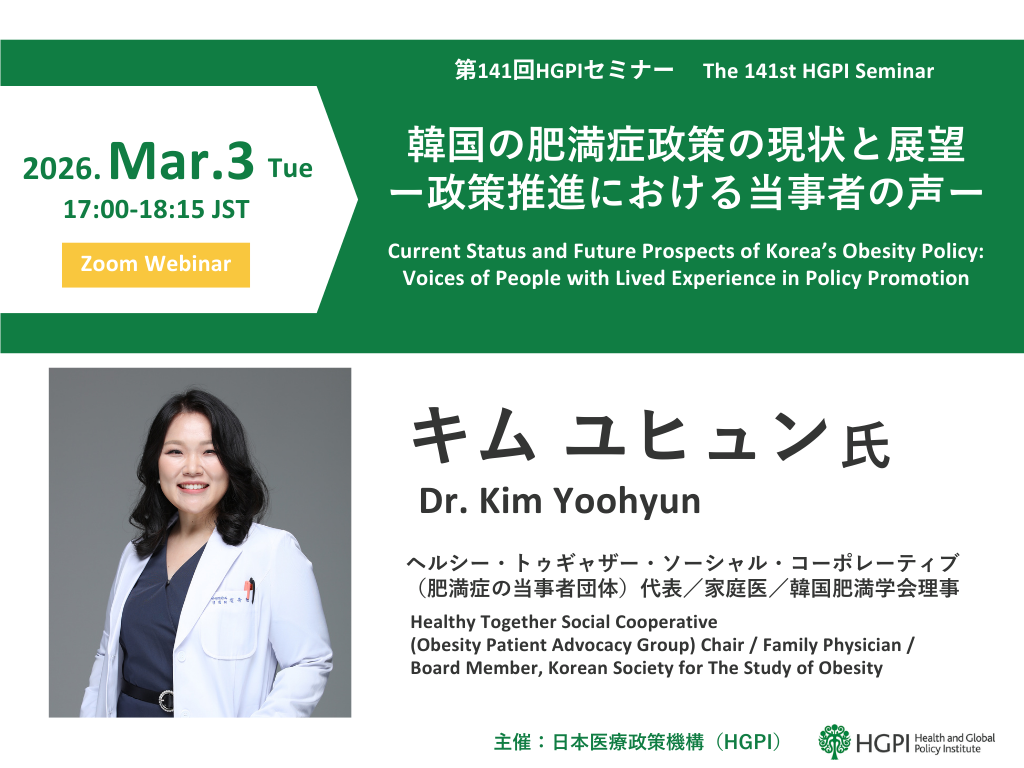
[Registration Open] (Webinar) The 141st HGPI Seminar “Current Status and Future Prospects of Korea’s Obesity Policy: Voices of People with Lived Experience in Policy Promotion” (March 3, 2026)
-
2025-12-12
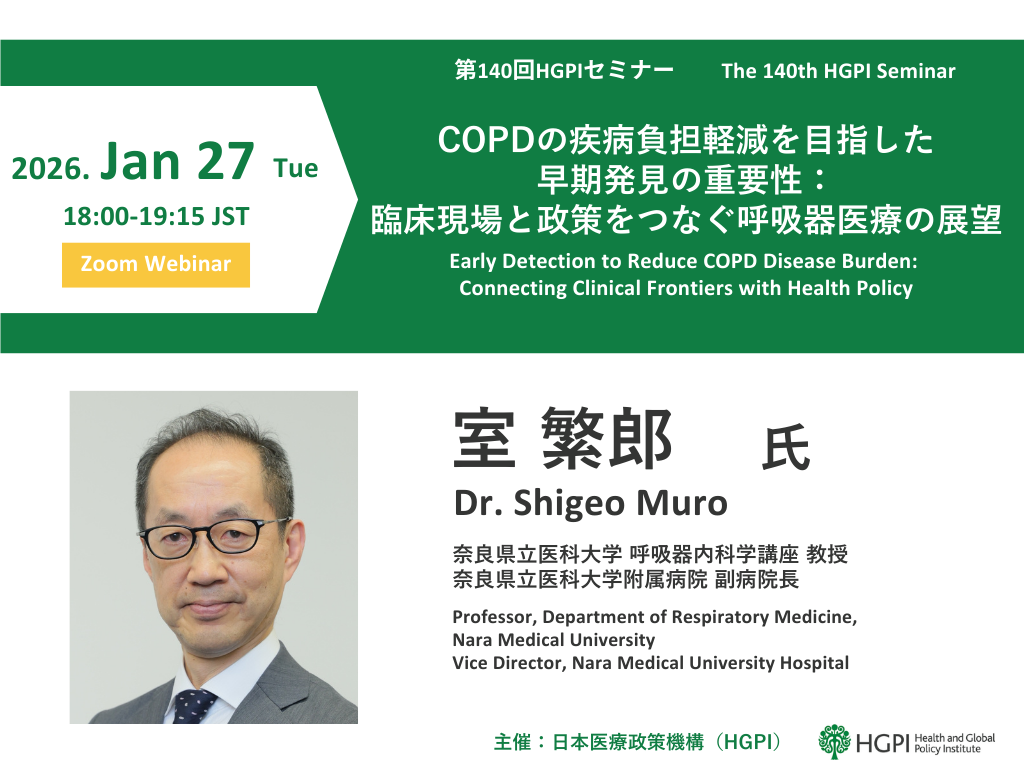
[Registration Closed] (Webinar) The 140th HGPI Seminar “Early Detection to Reduce COPD Disease Burden: Connecting Clinical Frontiers with Health Policy” (January 27, 2026)
-
2025-11-13
[Research Report] Perceptions, Knowledge, Actions and Perspectives of Healthcare Organizations in Japan in Relation to Climate Change and Health: A Cross-Sectional Study (November 13, 2025)
-

2025-12-03
[Event Report] “Climate Change and Health: Actions for the Future” (September 16, 2025)
Top Research & Recommendations Posts
- [Policy Recommendations] The Path to a Sustainable Healthcare System: Three Key Objectives for Public Deliberation (January 22, 2026)
- [Research Report] The 2025 Public Opinion Survey on Healthcare in Japan (March 17, 2025)
- [Research Report] Perceptions, Knowledge, Actions and Perspectives of Healthcare Organizations in Japan in Relation to Climate Change and Health: A Cross-Sectional Study (November 13, 2025)
- [Research Report] AMR Policy Update #4: Cancer Care and AMR (Part 1)
- [Policy Recommendations] Reshaping Japan’s Immunization Policy for Life Course Coverage and Vaccine Equity: Challenges and Prospects for an Era of Prevention and Health Promotion (April 25, 2025)
- [Research Report] The 2026 Public Opinion Survey on Healthcare in Japan (February 13, 2026)
- [Research Report] The 2023 Public Opinion Survey on Satisfaction in Healthcare in Japan and Healthcare Applications of Generative AI (January 11, 2024)
- [Policy Recommendations] Developing a National Health and Climate Strategy for Japan (June 26, 2024)
- [Public Comment Submission] “Assessment Report on Climate Change Impacts in Japan (Draft Overview)” (December 24, 2025)
- [Policy Recommendations] Mental Health Project: Recommendations on Three Issues in the Area of Mental Health (July 4, 2025)
Featured Posts
-
2026-01-09
[Registration Open] (Hybrid Format) Dementia Project FY2025 Initiative Concluding Symposium “The Future of Dementia Policy Surrounding Families and Others Who Care for People with Dementia” (March 9, 2026)
![[Registration Open] (Hybrid Format) Dementia Project FY2025 Initiative Concluding Symposium “The Future of Dementia Policy Surrounding Families and Others Who Care for People with Dementia” (March 9, 2026)](https://hgpi.org/en/wp-content/uploads/sites/2/dementia-20260309-top.png)
-
2026-02-05
[Registration Open] (Webinar) The 141st HGPI Seminar “Current Status and Future Prospects of Korea’s Obesity Policy: Voices of People with Lived Experience in Policy Promotion” (March 3, 2026)
-
2026-02-27
[Registration Open] (Webinar) The 142nd HGPI Seminar “World Kidney Day 2026” Theme in Focus: The Current State of Green Nephrology and Green Dialysis—Balancing Kidney Health and Planetary Health (March 10, 2026)
